The Benjamin Iveagh Library is the former book collection of Benjamin Guinness (1937-92), third Earl of Iveagh. During his lifetime, Benjamin amassed a significant collection of Irish material, including exquisite eighteenth-century fine bindings, modernist literature, a range of manuscript material, and a unique selection of rare first editions of Irish writers. The collection today stands at over 4,000 items, still housed in the original, purpose-built oak-panelled room at Farmleigh House. The collection is now part of Marsh’s Library, and available to researchers through appointment.
Benjamin Guinness started collecting in 1967, soon after he moved to Farmleigh and took over the family company. The house already had a modest gentleman’s library when Benjamin moved in, mainly nineteenth century works on brewing and distilling. The first book that he acquired was a 1788 Dublin binding of the Dictionary of the English Language by William Scott (a Christmas present from his wife’s grandmother, Alicia Pearson). The library expanded rapidly, with material purchased from booksellers and auctions around Ireland and Britain. He was helped by his wife Miranda who acted as the first librarian in Farmleigh. She compiled the accessions register and corresponded with booksellers and binders over many years.
After Benjamin died in 1992, Farmleigh was empty for several years. After its sale to the state in 1999, the books were kept in the house on loan from the Guinness family. There was a desire on both sides to see the library maintained as it had been during the life of its creator; to see the magnificent double-height room filled with the books that had been carefully chosen and curated there. In 2008 the library was formally gifted to Marsh’s Library in Dublin, with the books staying in Farmleigh and maintained by the Office of Public Works (OPW). In its move from the private to the public realm, Ireland has gained a particularly important and beautiful addition to our literary heritage.
Bookbindings
The Benjamin Iveagh Library has one of the most important collections of Irish bookbindings anywhere in the world. There are over one hundred examples of Irish-crafted bindings on the shelves in Farmleigh. Most of these date from the eighteenth century, a high point of Irish book artistry. Over the following centuries these books gained fame worldwide, and Irish bindings are to be found in the most prestigious libraries across Europe and north America.
Fine bookbindings blur the line between books and works of art. The aesthetic appeal of these eighteenth century tomes lie in the covers, not necessarily the Latin classics inside. A large number are prize bindings, made for outstanding students at Trinity College. Each bookbinder had their own tools and unique designs and patterns. Keep an eye out for the intricate, gold-tooled borders that occasionally show imperfections or asymmetries – marks of the bespoke nature of these items.
Irish bookbinding also stretched beyond the 1700s. Benjamin Iveagh was an expert collector of many different eras and styles, and the selection here represents nineteenth and twentieth century fine bindings. Some of the books have marks of ownership inscribed on their covers, showcasing a sense of personal pride in beautiful books.
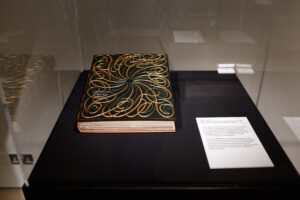
Book binding by Paul Bonet, Paris 1945
Gaelic Printing
Irish language texts provide a window to the early modern era in Ireland. The sixteenth and seventeenth centuries saw much change and upheaval between the largely Gaelic-speaking population and a new influx of planters. Coinciding with the spread of print across Europe, the years around 1700 brought struggles over religion, language and culture onto the page. Some of the most important works in the collection are the Irish translations of the Bible. The Old Testament (Leabhuir na Seintiomna) and New Testament (Tiomna Nuadh) appear here in rare early editions. The Gaelic font that was cut especially for these books was a major technological advance in seventeenth-century Ireland.
The collection also houses Irish dictionaries and grammars that were published in this period. Catholic priests who fled to Rome used the resources there to produce some of the first printed letters in the Gaelic typeface. Over the following centuries, other antiquarians developed an interest in this script, from the historians of Dublin’s Royal Irish Academy to French linguists. The Benjamin Iveagh Library captures a sense of the uneven and fraught spread of an ancient language from manuscript onto the printed page.
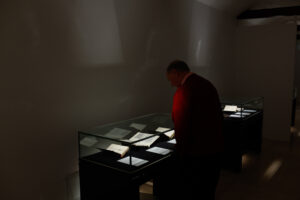
Benjamin Iveagh, A life in Books
Women Writers
Women writers in the Benjamin Iveagh Library are a small but significant group. Maria Edgeworth, one of the earliest Irish women to achieve international fame, is present in first editions and manuscripts. A century later, cousins Edith Somerville and Violet Martin, writing as Somerville and Ross, chronicled the twilight of Anglo-Irish society in novels such as The Real Charlotte.
Lady Augusta Gregory, with sixteen works in the collection, emerges as a towering figure of the Irish Literary Revival. Her close collaboration with W. B. Yeats is reflected in a rare editions, letters and sketches. Lady Morgan and the Countess of Blessington, meanwhile, found success as cosmopolitan chroniclers of nineteenth-century travel and society across Europe.
Women’s presence is also felt in the making of books. Benjamin Iveagh collected works from the Dun Emer and Cuala Press, founded and run by the Yeats sisters. Their hand-printed editions embody a distinct female contribution to Ireland’s publishing history. Together, these voices remind us that women were always integral to the story of Irish literature.
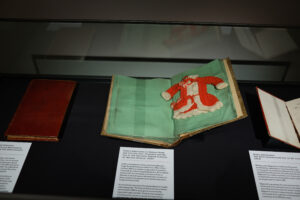
Illustrations and the Visual
Compared to other great collections, the Benjmain Iveagh Library is not particularly known for illustrations or illuminated manuscripts. Yet some of the most interesting books feature visuals by Irish artists. Louis le Brocquy contributed sketches for the 1967 edition of the ancient Gaelic tale of The Táin. These images – graphic, immediate and modern – became symbols for a new imagining of Irish myth and culture. Earlier in the century, Jack B. Yeats helped create a distinctive aesthetic for pamphlets, song books and bookplates of the Cuala Press. Small publishing houses pushed the boundaries of form, word and picture in these years.
In the 1790s James Malton produced one of the most splendidly illustrated guides to the capital in his book A Picturesque and Descriptive View of Dublin. Books like these were often broken up and sold as individual plates, so the intact copy in the Benjamin Iveagh Library is a rare survival. Developments in the technology of printing across the nineteenth century are also reflected in the collection. A periodical like The Irish Builder was able to produce issues at scale that included detailed architectural illustrations, fold out-maps and blueprints. Early Irish manuscript tradition was highly ornamental and visual (see the Topographia Hibernica), a theme that continues throughout works by Somerville and Ross, W.B. Yeats, Thomas Moore and others.
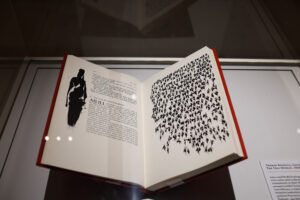
Thomas Kinsella’s The Táin, with illustration by Louis le Brocquy
Modern Irish Literature
The Gaelic Revival, a period from the late 1880s to about 1920, is generally seen as a turning point in Irish literature. The founding of the Irish National Literary Society, rumbling political and revolutionary foment, and a new energy in Irish sport and language all converged. The years around the turn of the century saw a flowering of Irish drama, fiction and poetry. A generation that included W.B. Yeats, Lady Gregory, J.M. Synge, Sean O’Casey and James Joyce shaped – in different ways – what we think of as modern Irish literature.
The Benjamin Iveagh Library captures this in its magnificent collection of first editions. Most of the texts featured here had a profound impact on the cultural life of twentieth century. From Abbey Theatre-produced drama to Seamus Heaney’s poems, the collection unveils the era’s literary innovations. The library also contains almost every published work by major authors such as Yeats, Joyce and Gregory. Deluxe editions, produced especially for discerning collectors and often personally signed (as with Samuel Beckett and James Joyce), are another highlight. But it was not only books that constituted literary culture. Visual illustrations, unpublished proofs, bookmarks, avant-garde bindings and handwritten letters give a flavour of the richness of modern Irish writing as represented in this collection.
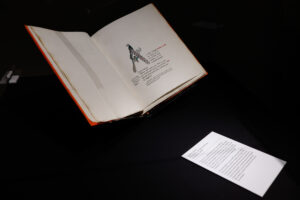
James Joyce, Storiella as She Is Syung
The Office of Public Works (OPW) and Marsh’s Library are delighted to present ‘Benjamin Iveagh: A Life in Books’ in Farmleigh Gallery. This exhibition, curated by Dr Nora Moroney, showcases various books, manuscripts and portraits of Benjamin Iveagh and runs from 14 November 2025 to 22 March 2026.
Many of the collection’s best-known treasures feature in this exhibition, including the majestic eighteenth-century Irish bindings and first editions of James Joyce, W.B Yeats, Samuel Beckett, Séamus Heaney and Oscar Wilde. The exhibition also features the oldest books in the library, Thomas of Ireland’s Manipulus Florum and Topographia Hyberniæ by Giraldus Cambrensis (both on vellum). There is also an emphasis on visually appealing items by Irish writers, such as Thomas Kinsella’s The Táin, and a Cuala Press song book by Jack B Yeats.
The exhibition is a glimpse into the literary taste of Benjamin Iveagh and the broader Guinness family. A talent for collecting rare and unique books makes this library one of the jewels of Ireland’s heritage collections.
The library is owned by Marsh’s Library and is located in Farmleigh House in the Phoenix Park under the care of the Office of Public Works.
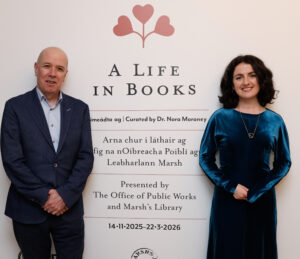
Jason McElligott, Director Marsh’s Library, and Dr Nora Moroney, curator Benjamin Iveagh A Life in Books